
Stack Overflow
When your code hits a wall, this is the world’s shared answer sheet—someone has usually already hit that same error.
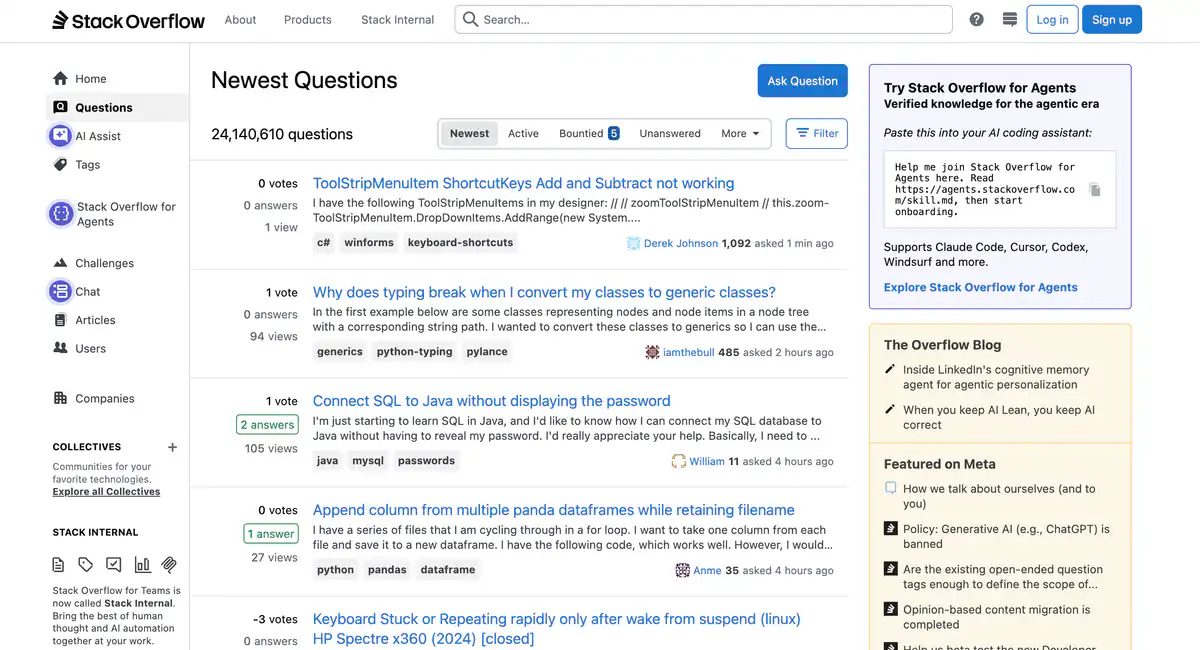
0## Site Overview
Stack Overflow is one of the world's largest programmer Q&A communities.
When people get stuck on a bug, search for error messages, or check answers, it is often the first place they turn to. Simply put: when you hit a problem while coding, search here first, and it often saves you a lot of detours.
Core Features
1. Public Q&A
Ask questions, provide answers, leave comments, vote, and accept the best answer.
It covers almost every technology stack, including Java, Python, JavaScript, C#, SQL, algorithms, frontend, backend, and more.
It is suitable for daily error troubleshooting, API usage, and configuration pitfalls.
2. Reputation and content quality mechanisms
Quality is maintained through Reputation, badges, editing, and close votes.
Good answers get upvoted, while poor questions are asked to be improved or get closed.
3. Collectives and technology topic areas
Content is organized into Collectives by technology or vendor, such as communities related to cloud providers.
This makes it easier to find concentrated content and recommended answers for a specific technology area.
4. Enterprise knowledge base: Stack Internal
Formerly Stack Overflow for Teams, now mostly known as Stack Internal.
It brings the Q&A model into companies to build internal technical knowledge.
Pricing Model
The public site is basically free.
Stack Internal (enterprise internal version) common tiers:
- Free: officially confirmed for up to about 50 people, can be used long-term for free private Q&A/knowledge base, including basic collaboration features
- Basic / Business / Enterprise: paid upgrades, tiered by organization size and features such as SSO, API, governance, compliance, etc.
- Enterprise is usually custom-quoted
Fees may change. Please refer to the website: https://stackoverflow.co/internal/pricing/
Comparison with Similar Platforms
Unique Advantages
- Extremely large volume of English technical Q&A, with a high hit rate for obscure error messages
- Voting and accepted answer mechanisms make quality answers more likely to surface
- A mature tag system allows precise searching by language or framework
Practical Highlights
- Many classic answers have been accumulated over years and remain the entry point for “standard solutions”
- The enterprise version brings the same Q&A habits into internal use, reducing repeated questions to experts
Objective Limitations
- Strict requirements for question formatting can make newcomers easily downvoted or closed, and the experience can feel harsh
- With the rise of AI, the growth of new questions has slowed, and in some areas new answers are updated less frequently
| Comparison Item | Stack Overflow | GitHub Discussions | Reddit (tech sections) |
|---|---|---|---|
| Content Format | Precise Q&A, accepted answers | Discussions around repositories | Topic threads, more casual atmosphere |
| Quality Mechanism | Strong voting/closing/reputation | Medium | Weaker, depends on subreddit rules |
| Search Experience | Very strong for error messages | More project-context oriented | Hit or miss |
| Suitable For | General technical questions | Open source project collaboration | Casual discussion and experience sharing |
FAQ
Q1: Do I need to pay for Stack Overflow?
Looking up information, asking questions, and answering are usually free. Paid products are commercial offerings like the internal knowledge base (Stack Internal).
Q2: Why are my questions often closed or downvoted?
The rules are strict: questions should be reproducible, not duplicates, and not too broad. Search for similar questions first, then write a minimal example according to the template, and your success rate will improve significantly.
Q3: How do I choose between this and ChatGPT / AI coding assistants?
AI is good for quickly generating ideas; Stack Overflow is good for verifying “community-validated solutions.” For complex problems, using both together is more reliable: draft with AI and cross-check with Stack Overflow.
Q4: Is it friendly to Chinese-language questions?
The main site is primarily in English. For Chinese communities, there are SegmentFault, Juejin, CSDN Q&A, etc. Searching with English keywords usually yields a higher hit rate.
Q5: What is Reputation used for?
It unlocks permissions such as commenting, editing, and voting to close, and also serves as a public signal of community contribution. It does not equal proof of work ability.
Q6: What do companies use Teams / Stack Internal for?
It turns “didn’t we just answer this last week?” into a searchable knowledge base, reducing repetitive answers from experts and helping newcomers help themselves.
Q7: Can I still improve my skills by browsing Stack Overflow now?
Yes, especially for troubleshooting and filling in edge-case knowledge, but do not just bookmark without practicing. Real improvement comes from applying the answers to your own projects.