
Messenger
Chat, call, and video with your Facebook circle—one inbox for the people you already know.
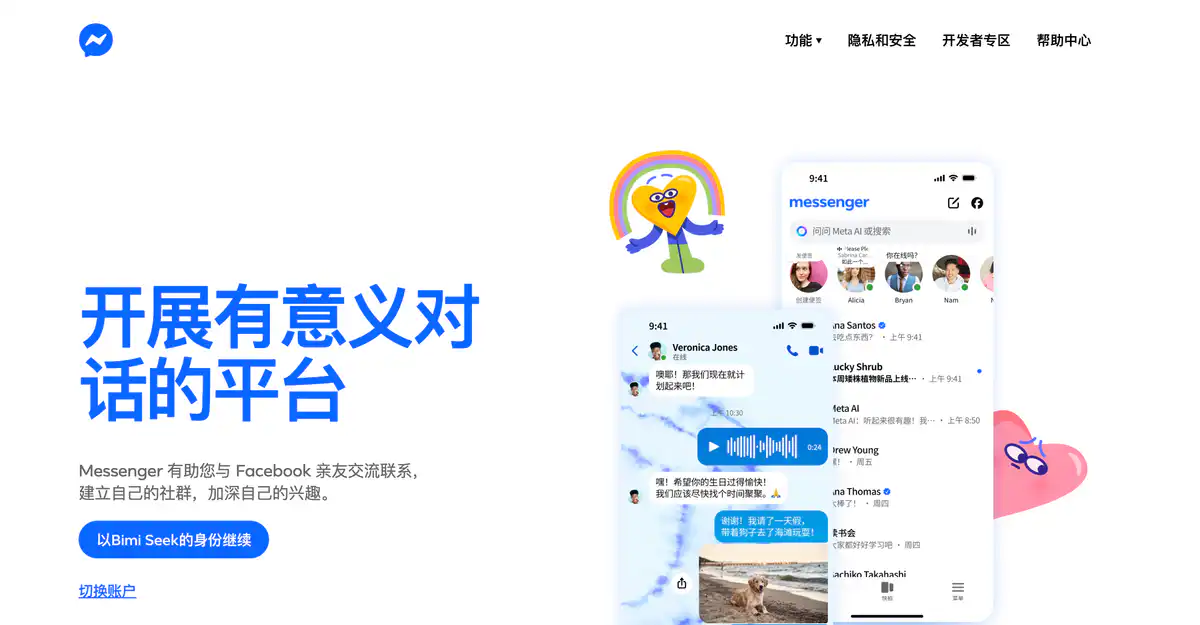
Overview
Messenger is an instant messaging product under Meta.
It is mainly used for chatting with Facebook friends, family, and acquaintances. Text, voice, video, photos, and file sharing can all be done in one app or on the web.
Core Features
1. Text Chat and Multimedia
Both private and group chats are supported.
It supports high-definition photos, voice/video messages, stickers, and chat themes.
2. Voice and HD Video Calls
Supports HD video calls with enhancements such as noise reduction.
If the other person doesn't answer, you can leave a voice or video message.
3. Message Control and Privacy Features
You can edit messages within about 15 minutes of sending them, and unsend messages at any time.
Includes disappearing messages similar to ephemeral messaging.
4. Communities, Channels, and Meta AI
Includes Communities for interest-based or school-related group chats with up to about 5,000 people, though availability may vary by region and platform.
You can follow creator Channels and view short updates such as Stories / Notes.
Pricing Model
Free for everyday personal use.
Prices are subject to change. Please refer to: https://www.messenger.com/
Comparison with Similar Platforms
Unique Advantages
- Deeply tied to Facebook social connections, making it easy to reach people you already know
- Full-featured web and mobile versions make it convenient to chat while working on a computer
- Many chat features: themes, stickers, albums, Stories, and more
Practical Highlights
- You don't necessarily need to exchange phone numbers to chat
- Personal chats are moving toward default end-to-end encryption, with much stronger privacy than in earlier versions
Limitations
- Strong dependency on the Meta/Facebook account system, making it less accessible for people who don't want to use Facebook
- Business conversations and some scenarios may not be end-to-end encrypted; privacy-sensitive users may prefer Signal / WhatsApp
| Comparison Item | Messenger | Telegram | |
|---|---|---|---|
| Social Graph | Mainly Facebook friends | Mainly phone contacts | More flexible via accounts/usernames |
| Encryption | Personal chats moving toward default E2EE | Default E2EE | Optional for secret chats; regular cloud chats differ |
| Web Experience | Mature | Requires phone to stay online and other limitations | Very strong |
| Best For | People already in the Facebook social circle | Frequent contact with family and close friends | Large groups, channels, and heavy multi-device chatting |
FAQ
Q1: Does Messenger cost money?
Personal messaging is basically free. Sending messages and making calls are usually free and only use data. Business automation and marketing are handled under separate business terms.
Q2: Can I use it without Facebook?
In most cases, a Meta/Facebook-related login is still required. There may have been special access methods in certain regions, but don't assume it can be used as a no-account guest app.
Q3: How do I choose between Messenger and WhatsApp?
If you mainly contact people in your phone contacts or need an international SMS replacement, WhatsApp is more common. If your friends are mainly on Facebook, Messenger is more natural. Many people install both.
Q4: Is it really end-to-end encrypted?
Personal messages and calls are moving toward default encryption. You can check this in your chat settings. Conversations with business accounts and some business tools usually do not use the same E2EE.
Q5: Is Messenger Rooms still available?
According to official information, it has been unavailable since around late 2023. You can use group voice or video calls instead.
Q6: Can I send large files?
The feature page mentions file sharing of about 100MB. For larger files, using a cloud storage link is more reliable.
Q7: Does it work well in mainland China?
Usability depends on network conditions and account environment, and it varies from person to person. A more stable local option is usually WeChat. Messenger is better suited for people who already have an overseas Facebook social circle.