
When something trends in China, it often breaks here first. A leading Chinese social platform for short posts, photos, video, and live streams—where celebrities, media, and netizens chase the news; free at the core, with optional membership perks.
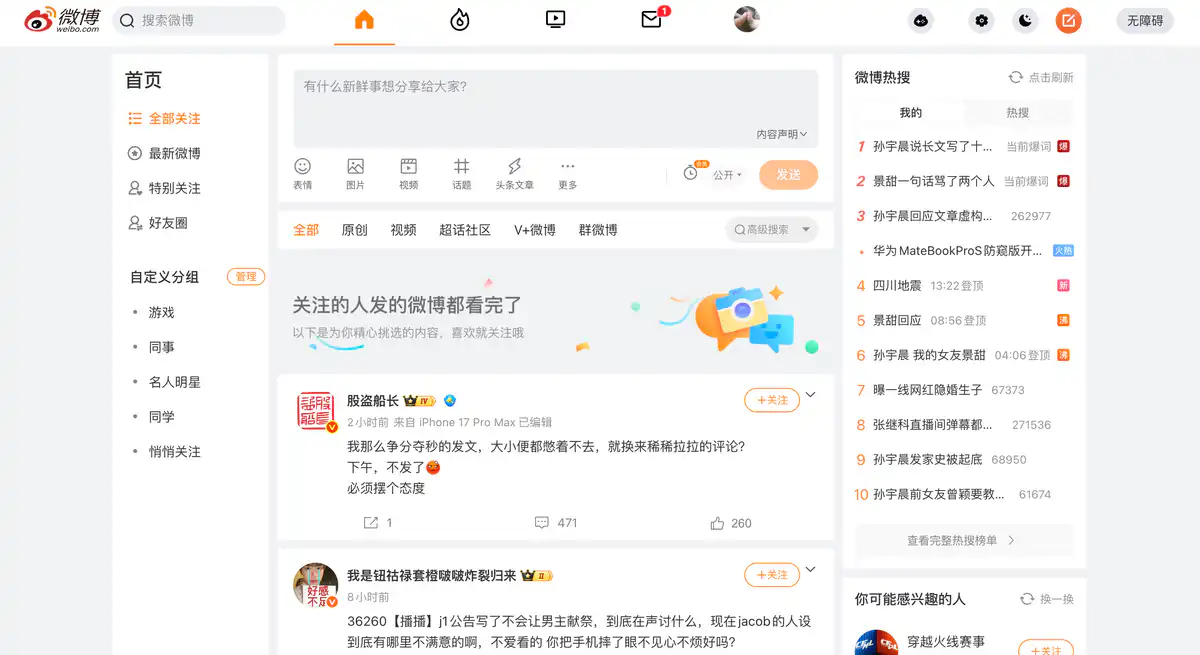
Site Introduction
The most active open social media platform on the Chinese internet, launched in 2009 and operated by Beijing WeiMeng ChuangKe Network Technology Co., Ltd.
Browse trending searches, follow celebrities, catch breaking news, and watch arguments unfold — 140-character short posts + repost chains spread information extremely fast.
Core Features
1. Posting and social interaction
Post text, images, videos, and polls; repost, comment, and like are the basic actions. Follow people you are interested in, and their updates will appear on your homepage timeline.
2. Hot search and trending topics
The hot search ranking reflects real-time attention across the entire platform. Entertainment, politics, social events, and brand sentiment can all brew here. Topic hashtags (#xxx#) gather related discussions together — essential for following trends and monitoring public opinion.
3. Super Topic communities
Super Topics are similar to interest groups + fan communities, where users check in, post, and complete tasks. Bloggers with at least 10,000 followers can also open a personal exclusive Super Topic to build a loyal fan base. Celebrities, esports, anime, and local life each have their own space.
4. Live streaming, video, and creator tools
Weibo Live, Video Channel, and V+ Membership (a paid subscription area set up by bloggers) are available for creator monetization. The Creator Center manages data, revenue, and ad revenue sharing; Micro Tasks connects brands with bloggers for commercial collaborations.
Pricing Model
Ordinary users: free.
After registering with a phone number, posting, following, browsing hot searches, and joining Super Topics are all free. Ads will appear in pages and the feed.
Weibo Membership (VIP / SVIP):
| Type | Common listed price (reference) | Main benefits |
|---|---|---|
| VIP Membership | Continuous monthly about ¥19.8/month | Red name, member badge, missed check-in cards, more name changes, themes, etc. |
| SVIP Advanced | Continuous monthly ¥25/month, single purchase ¥30/month | VIP benefits + more post editing times, flash chat, animated avatar, higher name change limit, etc. |
During major promotions (618, Double 11, etc.), annual cards often have special prices such as ¥45–60 (VIP) and ¥111–117 (SVIP) — these are not long-term fixed prices.
Other paid items:
- V+ Membership / True Fan: subscribe to a specific blogger's paid content; price set by the blogger
- Fan Headline: buy promotional exposure for a specific Weibo post, billed by campaign
- Micro Tasks: brands pay bloggers to post commercial content; pricing varies by account
Pricing may change; refer to the website: https://weibo.com/
Comparison with Similar Platforms
Unique advantages
- The number one entry point for Chinese trending topics — major social events, entertainment gossip, and brand sentiment all appear on the hot search with industry-leading speed.
- Strong public discussion arena — repost chains allow opinions to spread quickly, ideal for following current affairs and monitoring public opinion.
- Mature celebrity/KOL ecosystem — Super Topics, fan groups, and V+ provide complete fan management tools.
Practical highlights
- Hot search + topics combination lets you understand what the Chinese internet is talking about in five minutes.
- Super Topic check-ins are friendly for fans, with complete data, level, and task systems.
Objective limitations
- Many feed ads and marketing accounts — you may see them even without following anyone; experience varies by person.
- Community atmosphere is noisy — arguments and fan-circle fights are common under hot topics.
- Membership benefits lean toward cosmetic features — VIP mainly offers a red name, themes, and missed check-in cards, with limited practical value for ordinary users.
Similar tool comparison
| Comparison item | Xiaohongshu (RED) | X (Twitter) | |
|---|---|---|---|
| Positioning | Open short posts + trending public arena | Visual recommendations + lifestyle | Global short posts + real-time news |
| Free? | Basic features free | Basic features free | Basic features free |
| Content format | Short posts, video, live, Super Topics | Notes, images, short videos | Posts, Reels, Spaces |
| Trending ability | Extremely strong hot search ranking | Search and discovery based | For You + Trends |
| User ecosystem | Celebrities, media, government, general public | Recommendation bloggers, mostly young women | Media, tech, international users |
| Paid options | VIP/SVIP, V+, Fan Headline | No individual membership (creator tools) | X Premium |
| Main weakness | Many ads, toxic atmosphere | Not suitable for breaking news | Inconvenient access in China, weaker Chinese support |
FAQ
Q1: Can I use Weibo without paying?
Yes. Registration, posting, browsing hot searches, and viewing Super Topics are all free. Only VIP/SVIP cosmetic benefits, subscribing to bloggers' V+, and buying Fan Headline promotions require payment.
Q2: Is Weibo membership worth it?
Depends on your needs. Fans may need Super Topic missed check-in cards, want to change nicknames more often, or like red names and themes — VIP is useful. For simply browsing hot topics, the free version is completely sufficient.
Q3: What is the difference between VIP and SVIP?
SVIP is the advanced tier with more benefits: for example, more daily post edits, more name changes, flash chat, animated avatars, etc. See the membership privileges page for details.
Q4: What is V+ Membership?
It is a paid subscription area opened by bloggers; fans pay to access exclusive content (similar to Patreon). The price is set by the blogger, and access is through the "V+ Membership" entry on the blogger's profile.
Q5: How can I make money on Weibo?
Common paths: once you have enough followers, enable the ad sharing plan to earn revenue; accept brand deals through Micro Tasks; open V+ for subscription fees; or receive live-stream tips. See the Creator Center for requirements and rules.
Q6: Are hot search rankings bought?
Officially, hot search rankings are sorted by algorithms based on search volume, discussion volume, and spread influence, with anti-cheating mechanisms. However, controversy over brands buying hot search marketing has always existed. Hot search rankings are not entirely organic; judge for yourself.
Q7: How to choose between Weibo and Xiaohongshu?
For breaking news, celebrity updates, and public topics → Weibo. For product recommendations, reviews, and lifestyle guides → Xiaohongshu. Many people use both, for different purposes.